Flagship system
AI Research Agent
Agentic AI · Multi-Agent Systems · RAG
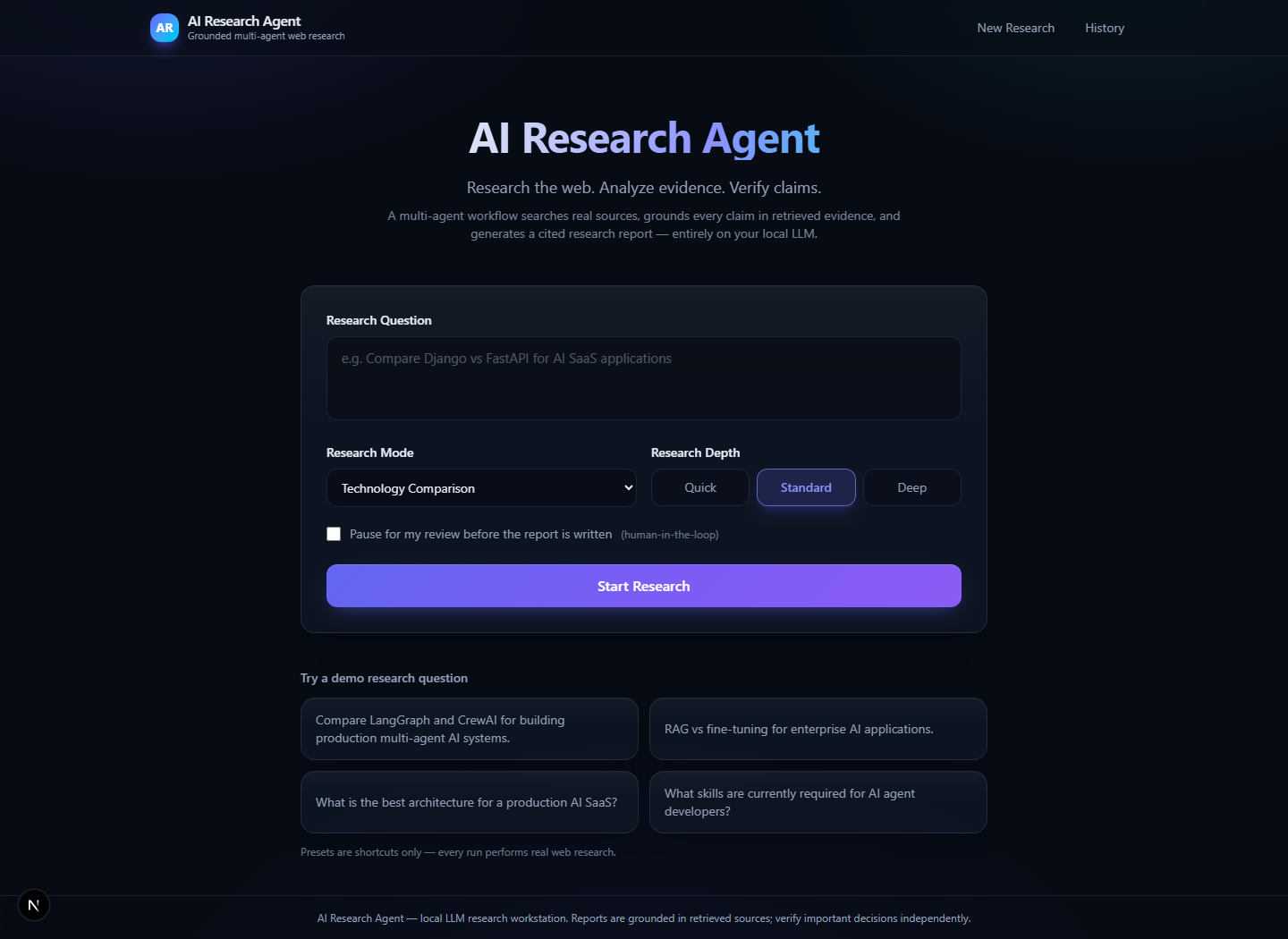
A local-first, multi-agent research workstation — LangGraph-orchestrated agents plan the research, search the real web, ground every finding in retrieved evidence, criticise their own analysis and write cited reports on a fully local LLM, with every citation verified against the session's own sources before publishing.
- 12
- Technologies
- 2
- Domains
- 8
- Capabilities
- 1
- Public links
Who it's for
Anyone who needs research they can actually trust — analysts, students, teams evaluating tools or markets — and engineers who want a working reference for agentic RAG done honestly.
Where it fits
A self-hosted research workstation on your own hardware: local LLM, local embeddings, local database, with only web search reaching out — no cloud AI ever sees the questions or the reports.
Screenshots
The hard part
The problem
LLM 'research' tools routinely hallucinate — they cite sources that were never read and state claims no evidence supports. Sridhar wanted an agent system where hallucination is prevented by construction, not by prompt-engineering hope: every claim must trace to evidence the system actually retrieved, or it does not get published.
Key constraints
Everything had to run locally except web search — local LLM via Ollama, local embeddings, local database — so grounded research works without sending data to a cloud AI. And the guarantees had to be structural: findings citing pages that were never fetched discarded deterministically, invalid citations stripped, weakly-supported statements disclosed rather than published as fact, and the self-correction loop hard-capped so it can never run away.
Architecture overview
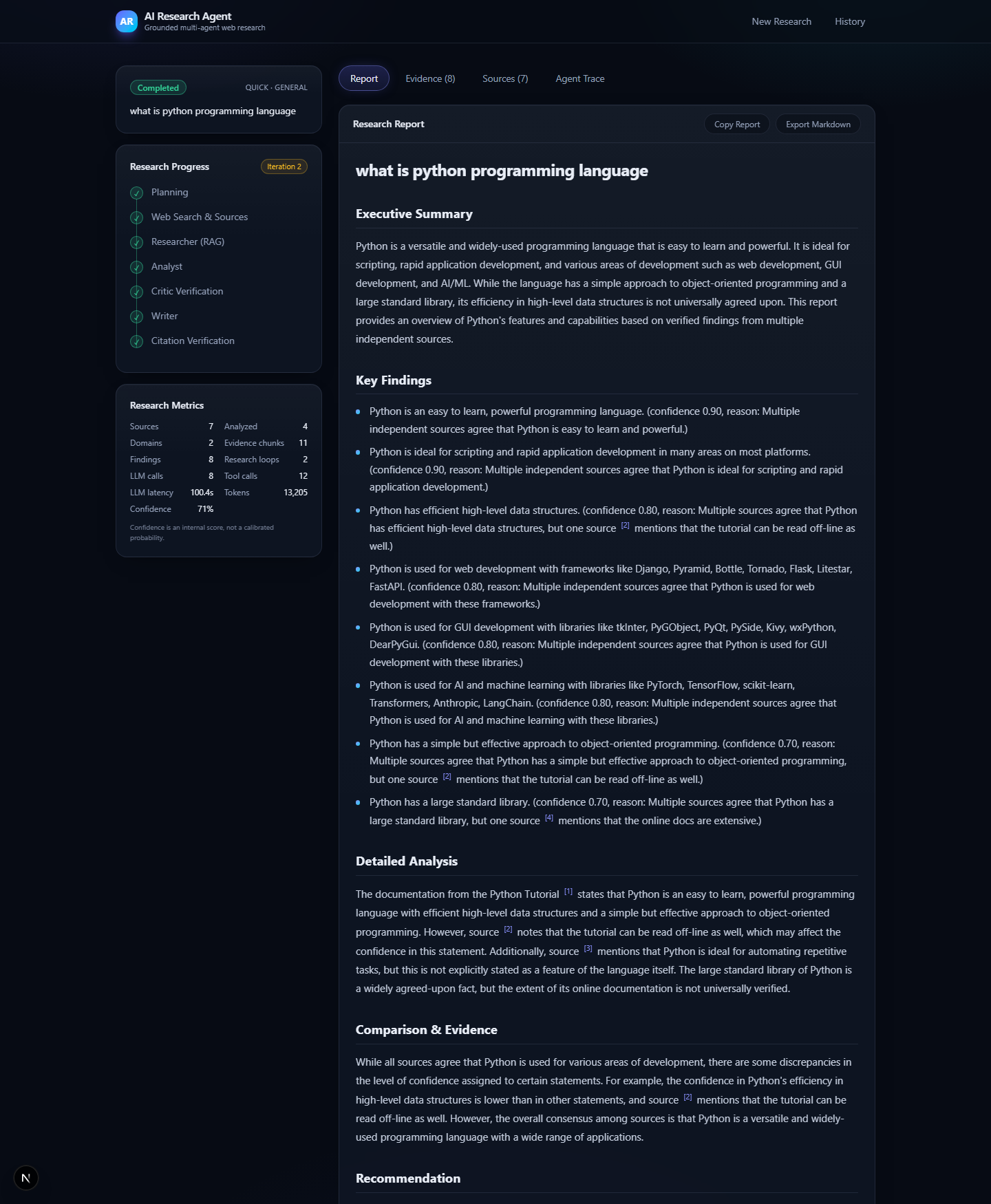
A LangGraph state machine orchestrates eight specialised agents — Planner, Researcher (collect + RAG findings), Analyst, Critic, optional human review, Writer and CitationVerifier — over one explicit shared state with no hidden globals. Sources flow through a robots.txt-aware fetcher into a per-session RAG index: chunks with full provenance, local embeddings, and hybrid retrieval fusing dense cosine similarity with a BM25 keyword index via reciprocal rank fusion. A FastAPI backend streams live agent progress over Server-Sent Events to a Next.js research-workstation UI showing sources, evidence, traces and metrics.
Confidence gate → human review
How it works
What's actually in it.
- 01LangGraph workflow with a conditional verification loop: Planner → Researcher → Analyst → Critic, looping back to refined research on rejection (hard-capped at 2 iterations), then Writer → CitationVerifier.
- 02Per-session RAG pipeline: word-window chunking with overlap and provenance, batched content-hash-cached embeddings, and a pgvector → FAISS → numpy auto-selection chain for the vector store.
- 03Hybrid retrieval by default — dense cosine similarity fused with a per-session BM25 keyword index via reciprocal rank fusion, so exact terms embeddings blur (product names, APIs, versions) still hit.
- 04Claim-level citation verification: every factual sentence is checked against retrieved evidence as SUPPORTED / PARTIALLY_SUPPORTED / UNSUPPORTED; invalid citations are stripped and weak ones disclosed in Limitations.
- 05Schema-constrained decoding via Ollama's JSON-Schema format option, with retry and salvage parsing — plus num_predict caps after a real run caught a 3B model looping to 19k tokens inside a JSON string.
- 06Failure recovery throughout: search-provider fallback chain (Tavily → DuckDuckGo → SearXNG), per-source unavailability handling, and honest 'insufficient evidence' errors instead of silent model-knowledge fallback.
- 07Live observability: SSE-streamed agent timeline, per-agent traces (status, duration, token usage), metrics panel and per-session reproducibility config with versioned prompts.
- 08Evaluation harness running real research sessions over a question dataset, scoring citation coverage, groundedness, completeness, retrieval relevance and latency — rendered in an in-app dashboard where every benchmark row links to the full inspectable session.
Engineering decisions
A Critic agent that can send the whole workflow back
Most agent pipelines are a one-way conveyor belt: plan, search, write, ship — whatever the model produced goes out. Here the Critic is a real gate in the state machine: it checks the analysis against the retrieved evidence and, when evidence is insufficient, loops the workflow back to research with refined queries — bounded at two iterations so it can never loop forever. The report cannot be written until the Critic approves or iterations exhaust, and even then every [n] citation is verified against the session's own collected sources — semantically, in vector space — before publishing.
The trade-off
The verification loop costs real latency: a standard run takes ~2.5 minutes on a local 3B model, largely because the strict Critic rejects the first pass and forces a second research round. That cost is deliberate — a quick mode trades the critic loop for ~2× lower latency while keeping URL grounding and citation verification fully active, and the measured result is that quick mode actually gains citation coverage by publishing fewer, better-grounded claims.
The obvious approach
Prompt a hosted LLM to 'research this and cite your sources' — the standard chatbot-with-search approach.
Why I didn't choose it
The model happily invents citations, references pages it never fetched and states claims no source supports — and with a cloud API the only fix available is asking more nicely in the prompt.
My approach
Make hallucination structurally unpublishable: schema-constrained JSON decoding so the model cannot emit malformed output, deterministic discarding of findings that cite un-fetched URLs, a Critic gate that blocks writing until evidence suffices, and claim-level citation verification against the session's own evidence — with uncited claims that a real source verifiably supports getting the citation attached automatically.
Trade-offs
A full state machine, RAG pipeline and verification layer to build and test — far more machinery than a prompt — in exchange for reports where every published claim traces to real retrieved evidence.
Technical highlights
- Hallucination reduction is structural, not hopeful — six independent guards between the model and the published report.
- Runs entirely locally except web search: local LLM, local embeddings, local database, no API keys required for grounded output.
- Human-in-the-loop review gate that auto-approves on timeout, so autonomous runs never hang.
Claims & evidence
Claim-level citation verification lifted citation coverage from 0% to 60–86% depending on mode — measured on real runs of the same pipeline before and after.
Measured · AI Research Agent evaluation runs (docs/evaluation.md, benchmarked 2026-08-24)
Benchmarked end to end on two local models: 100% completion, 78–79% overall quality, fastest single run 29.8s on qwen3:1.7b.
Measured · AI Research Agent evaluation dashboard (2 questions per model/mode cell, real research runs)
Quick mode measured at 64s end to end on a local 3B model after profiling-led optimisation, down from a 118–129s baseline.
Measured · AI Research Agent performance instrumentation (per-stage timing)
38 tests passing (27 backend, 11 frontend) covering the critic rejection loop, iteration caps, citation stripping and fabricated-URL discarding — all web, LLM and search calls mocked.
Measured · AI Research Agent test suite (pytest + vitest)
Every statement above carries its evidence class — nothing is invented.
Tech stack
- Python 3.12
- LangGraph
- FastAPI
- Pydantic v2
- Ollama (local LLM)
- PostgreSQL + pgvector
- sentence-transformers
- FAISS
- Next.js 16
- TypeScript
- Tailwind 4
- Docker Compose
Want to go deeper on AI Research Agent?
I'm happy to walk through the architecture and the decisions behind it.